Thursday, March 12, 2015

Vicksburg National Military Park

No visit to Vicksburg would be complete without a tour of the Civil War battlefield.  That 1863 battle had such an impact on the city of Vicksburg you can still see the effects of it today. President Lincoln called Vicksburg "the key" to winning the war and sent General Grant to clear the Mississippi of 
Confederate resistance.  We had toured the battlefield many years ago but we were in a hurry to get home then and didn't really take the time to understand everything we saw - so it deserved a second look!

We began our visit in the small visitor's center where we saw....

.....exhibits on the life of soldiers and officers in the field......

.......and exhibits on the lives of the citizens of Vicksburg who left their homes and waited out the bombardment, and siege, in caves they dug into the hillsides.

When Grant's direct attacks on the city failed, he began a formal siege.  He set up artillery batteries to hammer the Confederate fortifications from the land side while gunboats blasted the city from the river.  Massive trenches were dug by both sides of the conflict and they remain today.

The Shirley House is the only surviving wartime structure in the park.  During the siege it served as headquarters for the 45th Illinois Infantry.  The owners refused to leave and took refuge in the basement.

This battlefield, like all the other ones we have visited, has it's share of war memorials and cannons.  But, perhaps, the nicest one we've ever seen in the Illinois Monument built near the Shirley House.

However, the most impressive sight in the park is the miles of trenches that were hand dug by thousands of men in an attempt to avoid being hit by enemy sharpshooters.

Many of the trenches were within hailing distance of the enemy.

Union troops dug a tunnel beneath this road to avoid crossing a ridge where they would be exposed to Confederate fire.  It was said they "fought with a gun in one hand and a shovel in the other."

The important Navel contribution was not forgotten either.  This monument is flanked on each side by the important commanders of the gunboats that pressed Vicksburg from the water.

Also, along the 16 mile tour, is the first vessel ever sunk by a mine.  On December 12, 1862, the Union ironclad gunboat Cairo, along with several other vessels had tried to destroy Confederate batteries when, suddenly, two quick explosions tore holes in the Cairo's bottom.  It sunk in minutes.  

In the 1960s the boat's remains, and many of the crew's personal gear, were salvaged from the bottom of the river.

Unlike most of the other states, Missouri has a monument to men who fought on both sides of the war since it's citizenry were divided in their beliefs.

Finally, after 46 long days of siege, Confederate General Pemberton met with General Grant to discuss terms of surrender.  On July 4, 1863 Vicksburg was officially surrendered.

Wednesday, March 4, 2015

Out and About in Vicksburg

One weekend, we just drove around Vicksburg scouting out places we wanted to see while we are here.  We also ate at a couple of wonderful restaurants so I thought I'd just share a little of what is in our new neighborhood.

There are lots of beautiful homes in this town that are now bed and breakfasts.  This house was a bed and breakfast when we stayed here on our way home from my parents 50th wedding anniversary celebration over 10 years ago.  Now it appears to be a private home but it was nice to see it again.

Cedar Grove is one of the many B & Bs and is also a tour home.  It was built in 1840 and survived the siege and bombing of Vicksburg by becoming a hospital for the Union wounded.  It is on my list!

Looking very similar to Cedar Grove is Anchuca Mansion built in 1830.  It is also a B & B and available for tours.

The Duff Green Mansion, built in 1856, is also a B & B and tour home.  During the Siege of Vicksburg it was hit numerous times by Union cannonball.  In an effort to save their home the owners allowed it to become a field hospital for both Confederate and Union wounded.  Meanwhile, the owners waited out the bombing with many of Vicksburg's citizens in caves dug into the hillsides.

Walnut Hills Restaurant has quickly become one of my favorite places to eat.  It is located in a home built in the 1880s and has delicious food.  Southern Living Magazine agreed with me and featured the restaurant in one of it's issues.

Strangely enough, one of the best buffets anywhere is at the Ameristar Casino.  Their all you can eat Friday night seafood buffet is fabulous!  I've never seen so many crab legs in one place before.


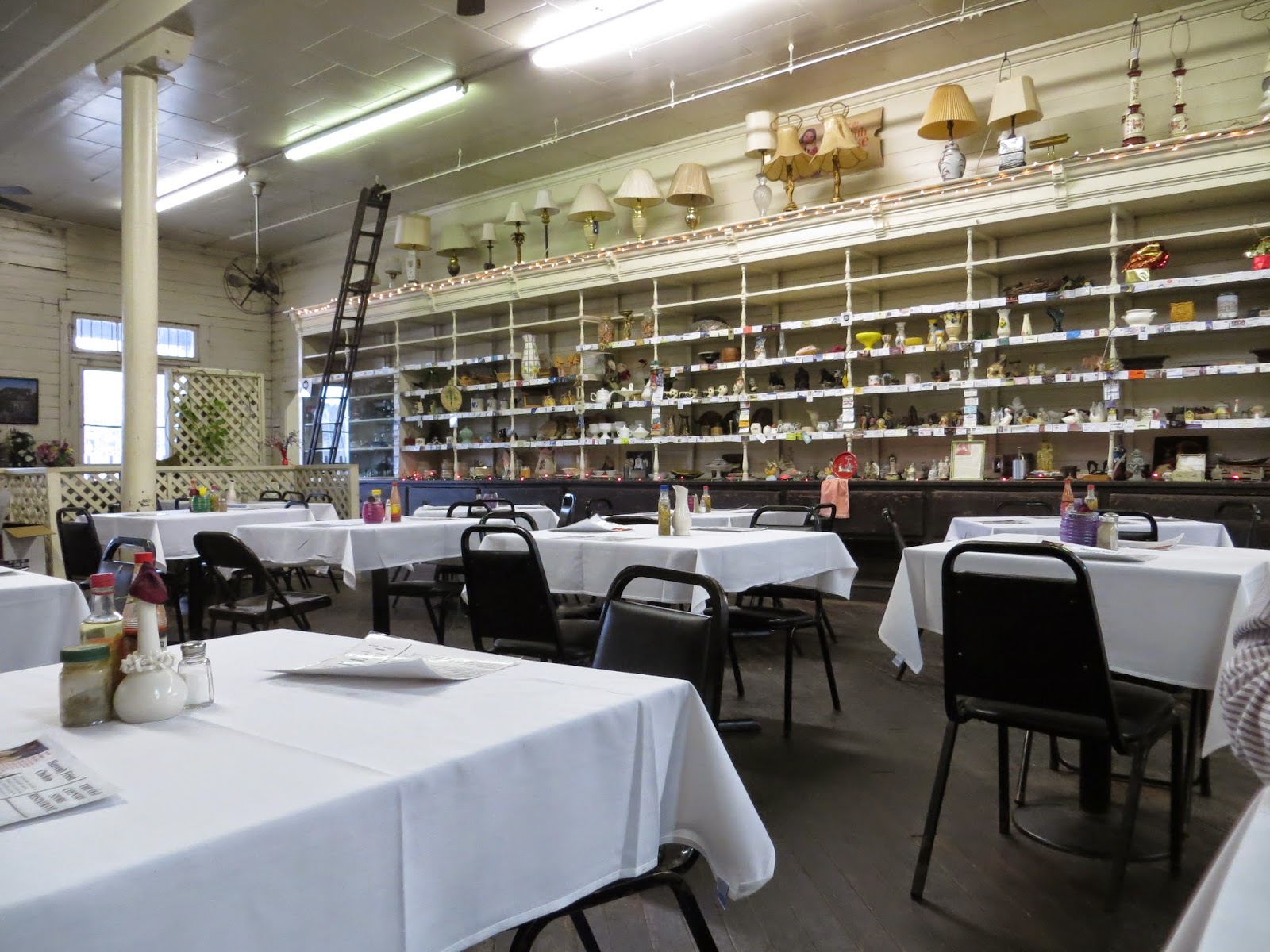
Even stranger still is the absolutely delicious fried chicken served up at the Old Country Store in nearby Lorman, Mississippi.  From the outside it looks like an old store.

But, inside, between shelves lined with antiques to buy, are tables where we chowed down on the best fried chicken we've ever tasted.  Southern Living Magazine did an article on this place too.

The Food Network's Alton Brown declared that if he was going to eat fried chicken he wanted to eat Mr. D's (Davis) chicken or his own.  Richard has a new best friend!  Mr. D even serenaded us - and he has a great voice!

When we left, Mr. D wrote a note to us on a copy of the Southern Living Magazine article.  I wonder if he gave one to Matthew McConaughey when he ate there a couple of weeks ago.

There's lots to see and do in the area - and we have just begun!


Tuesday, February 24, 2015

Windsor Ruins in Mississippi

Snow and ice have made an unwelcome appearance here in Mississippi, but before it arrived we had the opportunity to visit the magnificent Windsor Ruins.  Windsor was a plantation owned by Smith Daniel II, his wife Catherine and their seven children (only three survived to adulthood).  Smith completed his home in 1861 using slave labor.  Skilled carpenters from New England were brought in to complete the interior woodwork.

The columns are 45 feet high and made of bricks covered with mortar and plaster.  It cost $175,000 to build - equivalent to $4,593,426 in today's dollars.  Unfortunately, Daniel only lived in the house a few weeks before dying at the age of 34.  His wife and children continued to live in the home and throw many lavish parties.

There were 25 rooms, each with it's own fireplace, and interior baths fed by a water tank on the roof.

The mansion had four floors and a cupola.  The main floor was the 2nd floor, containing a broad hall, two parlors, a bathroom, the master bedroom, a study, a library, and the dining room.  The ground floor had the kitchen, schoolroom, commissary, and doctor's office.

The 3rd floor had another bathroom and nine bedrooms with the 4th floor serving as the ballroom.  During the Civil War, both Union and Confederate troops used the house as a hospital and observation station.  Mark Twain actually stayed at the home and viewed his beloved Mississippi River from the cupola.

Surprisingly, Windsor survived the Civil War only to burn down on February 17, 1890 when the family was away.  Someone, a guest or worker, left a lighted cigar on an upper balcony burning down the mansion, leaving only 23 of the 29 columns and a lone metal staircase.  This picture was taken in 1901.

All the house plans and records were destroyed in the fire so no one really knew what the mansion looked like until, in 1991, a drawing was discovered in someone's attic.  Henry Otis Dwight, an officer in the 20th Ohio Infantry, had sketched Windsor when his troop was camped on the grounds in 1863.

Despite it's fairly remote location, the remains have served as settings for several movies, including 1957's Raintree County starring Montgomery Clift and Elizabeth Taylor.  In a scene in the movie they ascend the staircase and Taylor tells Clift about how her home had burned when she was a child.

Eventually, the staircase was removed and installed in the chapel at nearby Alcorn State University.  In 1971, the Daniel descendants donated the ruins to the state of Mississippi who oversees the property now.

We certainly enjoyed our tour of some Mississippi history.  We can't wait to see more.  If only the weather would cooperate!

Wednesday, February 18, 2015

Grand Gulf, Mississippi

Last weekend we began exploring the state of Mississippi.  I'm planning on visiting plenty of Antebellum mansions while we're here, but our first stop was the town of Grand Gulf:  one-time boom town, major river port, theater center, and a strategic Confederate stronghold during the Civil War.

Today it is a virtual ghost town.  Originally settled by the French in the early 1700s, it became a major port city on the Mississippi River.  Prosperous plantation owners shipped loads of cotton to northern textile mills from here.

There was even talk of Grand Gulf as a possible site for the state capital - until several disasters hit the area.  Yellow fever turned into an epidemic, claiming the lives of many of the town's citizens.  Then a devastating tornado ravaged the town.  Finally, the currents of the mighty Mississippi River ate away the entire 55 block business section of Grand Gulf.

The Civil War destroyed what little was left of the town, with Union forces twice occupying the area, then burning the few remaining buildings to the ground before withdrawing.

The few inhabitants today still do battle with the river!

Not far from town is the Grand Gulf Military Monument dedicated to the battle fought here during the Civil War.

The small museum has some excellent displays on life in the area during the war.

Outside the museum are various buildings and displays.  This is a re-creation of the jail at Grand Gulf.

This is no re-creation though!  This is the actual cell they used.  They dug it out of the river mud.

 This is a hearse from New Orleans.  The sign says "people were dying to ride in it."

After viewing the displays near the museum, we took a driving tour of the 400 acre landmark which includes this church transported here from the nearby ghost town of Rodney, Mississippi.

One of the most interesting sights on the driving tour was the Grand Gulf Cemetery.

Most of the people buried in this, rather large, cemetery died long before the Civil War started.

As we wandered among the tombstones the thing that struck me the most was how young most of these people were when they died.  There were way too many children here too.

There was a lot to see at Grand Gulf but we had more miles to go!

Tuesday, February 10, 2015

New Job, New Location

It's hard to believe that it's been the beginning of November since I blogged!  We drove back to Arizona from the job in Pennsylvania (so glad I'm not there now!) in time to celebrate Thanksgiving with the family.  A few months home, and we left Arizona two weeks ago for a new nuclear power plant near Vicksburg, Mississippi.  What did we do while we were home?

We played with our grandsons..........

........watched a hockey game........

..........went to the zoo.......

...........helped put together a LOT of Leggos..........

.........saw a wonderful Christmas program.......

..........had a few meals with the family........

........celebrated Christmas with lots of gifts........

..........did some re-decorating at our mountain cabin in Pine...........

..........and did some outdoor work before..........

................it snowed!

All too soon, it was time to pack up the 5th wheel and head to another job.  We'll start doing a little sightseeing this weekend and I'll be blogging about our new adventures.  We're not in Arizona anymore!